

Punters are facing a sharp and sudden increase in bookmaker margins this month, with fixed odds market percentages ballooning well beyond historical norms.
New analysis provided by Taylor Collison shows a significant jump in market over-rounds across most major wagering operators.
The over-round measures how much it would cost to back every runner in a race to return $100.
These figures are based on the final fixed odds starting price, which gives a reasonable proxy for margins, but does not capture the true flow of the market including who is up when and at what percentage.
Traditionally this has sat between 118 percent and 123 percent in Australian racing, influenced by field sizes, weather and code. Higher over-rounds mean worse value for customers. Over time, shrinking value leads to shrinking turnover.
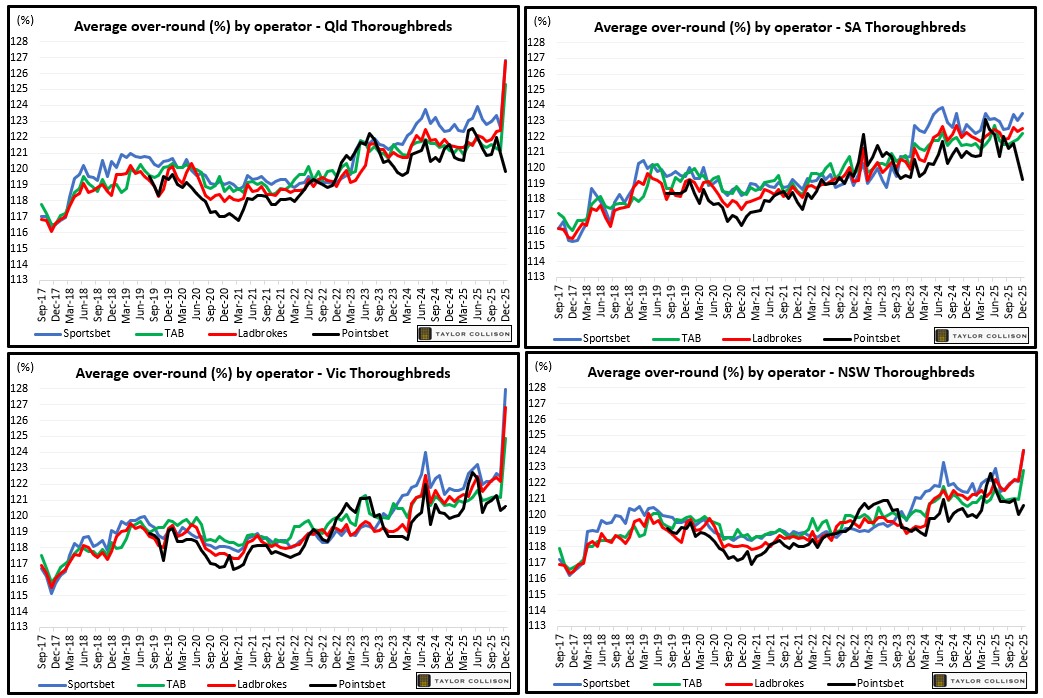
Market percentages have been trending higher for several years. When PoCT was first introduced in 2018 the average over-round was around 119 percent. Now it is consistently edging past 123 percent in many jurisdictions, and we are seeing an obvious spike again in December.
This graph shows trends in the average SP over-round by state.
Taylor Collison Gaming Analyst Andy Orbach says the move is sharp and concentrated.
“Dec, only 9 days obviously, but Qld being punished badly.”
He notes that bookmakers appear to be clawing back margins after a tough Spring Carnival.
“Put simply, over-rounds have jumped steeply as a form of margin clawback from operators having lost so heavily throughout the Spring Racing Carnival.”
The data suggests this is not limited to one state or code.
“We expected Qld to be on receiving end given PoCT was not reduced from 20 percent to 15 percent recently from McGrath Review. Seems Vic also impacted and NSW not immune either.”
One operator stands out from the pack.
“PointsBet (PBH) appear to be a clear exception, sitting well below competitors. Kudos to it for having the sharpest pricing of the majors.”
Meanwhile, Orbach sees evidence that some larger operators are prioritising profitability.
“Entain seemingly being run for profitability.”
Some astute punters track over-rounds and can see the value being stripped away in real time. Most recreational punters do not. They only find out when their bank is disappearing ever so slightly quicker each week. When value erodes, punters reduce their stake or walk away. That risks a hit to wagering turnover, which ultimately flows back into racing’s funding model.
Orbach raises the long term concern.
“Once a book pockets a margin increase, does it to some extent become anchored at the new level? Net loser as always is the punter.”
Markets at 125 to 126 percent in Queensland are becoming common among the major bookmakers. There is little sign of relief for the rest of the country either.
“Not much to get excited about here.”
Bookmakers are entitled to manage their businesses, but value is racing’s lifeblood.
When customers feel squeezed, betting activity drops and the industry pays the cost. Operators may view this as a short term recovery period. The big question is whether these elevated market percentages drift back down in the new year or remain the new norm.
Punters are watching. So should racing.