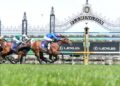
![Jockey James McDonald [Racing Photos]](https://betsy.com.au/wp-content/uploads/2025/09/Pink-Background-2.png)

Was James McDonald’s penalty for breaking the outdated and the under-specific whip rules enough?
Sure, he will probably miss two meetings as a 10-day ban was reduced to six and his fine was doubled to $40,000.
But he will be able to ride at the Hobartville Stakes meeting at Rosehill on Saturday week or three Group 1s on Blue Diamond Day where he will easily cover the extra $20,000? He might even get to Hong Kong on Sunday as well.
The penalty sounds big, but for the biggest concern, to the image of racing, it was not enough.
McDonald was charged with excessive use of the whip, but it is a charge that lawyers drive a truck through because of the way the rule is written.
The World’s Best Jockey played by the rules, and they fell in his favour.
McDonald’s lawyer Wayne Pasterfield once again exposed the whip rule for the farce it is.
He even implored the Appeal Panel to recommend it be changed, which wasn’t the first time that the Appeal Panel has heard such a plea.
“A quagmire of uncertainty” and “a mire of confusion” where the jockey is allowed unfettered use in the final 100m of any race was how Pasterfield echoed the general feeling around the whip rule.
McDonald had pleaded guilty to the charge, and didn’t change his plea for the 20 strikes in total and nine before the 100m mark, which breached the first part of the rule by four.
The rule has been bedevilled by appeals since it came into existence because the way it is written and needs to be reconstituted to give certainty.
That means a total number of strikes allowed.
As far back as 2018, Tim Hale, who was then the Appeal Panel head, said the rule “lacks the same clarity” in terms of the final 100m in a case involving Damian Lane breaching it, winning the Sires on Eldorado Dreaming.
“It provides that prior to the 100 metres mark the whip must not be used on more than five occasions. That much is clear,” Hale wrote.
He indicated that any rule that is so open to interpretation will lead to problems, as the whip rules continually does.
“I nevertheless consider I should draw attention to some of the difficulties of interpretation. This may be of some assistance in any future redrafting of the rules of racing,” he continued.
He offered the only numerical reference of five strikes before the 100m is a folly within the rule because over different distances, this may not be practical.
“There is no numerical limit on whip use. There will, of course, be a practical limit on whip use in the final 100 metres as there will only be finite or limited numbers of occasions on which the rider will be able to use the whip,” Hale wrote.
“The permitted whip use is to be determined by reference to an uncertain numerical standard, being the maximum number of occasions that a rider would be practically able to use the whip in the final 100 metres.”
“Even well informed and experienced minds are likely to disagree on what that number is.”
So we have had legal minds pointing towards a rewrite to clarify the rule for nearly a decade. The stewards have placed an arbitrary number on what is considered in each state, but it doesn’t appear in the rules, so on appeal fails to stand up.
The UK rule, where the number is six, and the horse needs to be allowed to respond before being struck, has its benefits. It is a rule McDonald fell foul of on Artorius in 2023 and was given 14 days and 400 quid.
Hale did raise forfeiture of prizemoney in his ruling, which is available under the rules as well as, or instead of a fine.
This would stop a happy winning owner helping cover the fine for their jockey and might even take away the discussion of fines being used as tax deductions. But that is for another day.
The whip rules should be changed and changed quickly, with most Australian chief stewards together at the Asian Racing Conference in Saudi Arabia, they should sit down and get it done.