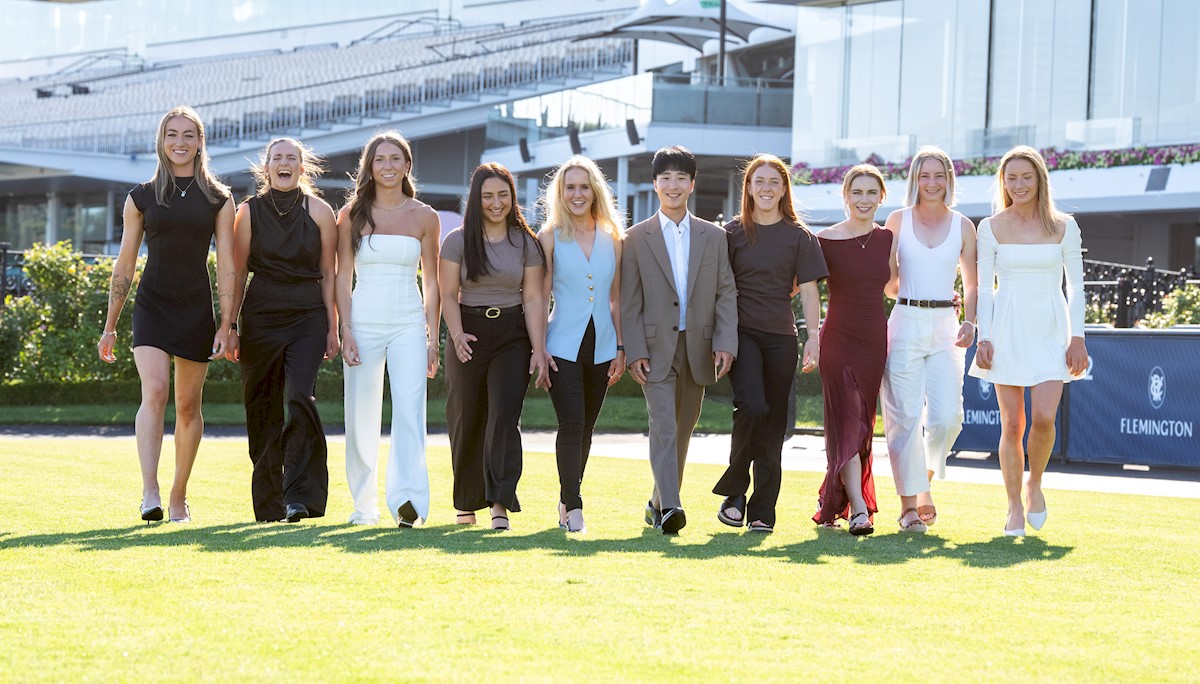

Inside Racing Victoria’s elite apprentice academy sit ten new jockeys – and only one of them is male.
In one of the few professional sports in the world where men and women compete on equal terms, nine of this latest intake are female, continuing a trend that is reshaping the industry.
The numbers tell the story. Of the 42 currently licensed apprentices in Victoria, 74 per cent are women, highlighting the changing face of racing’s next generation.
When you look back over the last decade, Racing Victoria has taken on 81 apprentice jockeys, where again 74% [60] were female.
And when you examine the graduates from the past three years, a remarkable 88 per cent have been female.
With the emergence of successful female jockeys, headlined by the Melbourne Cup heroics of Michelle Payne, Derby exploits of Clare Lindop and Jamie Melham’s historic Caulfield/Melbourne Cup double last year, there is a popular, albeit wrong, belief it’s a direction racing is purposely choosing.
But the truth is that racing has a man drought.
‘’I think the misconception is we are only choosing girls, which is not correct,’’ Racing Victoria’s Danielle Smith said, who is the Workforce Development Program Lead for the apprentice program.
‘’We actually are really struggling to get males through the door. We do a lot of work with Pony Clubs … but we barely see boys at Pony Club.”
‘’We don’t see them coming through, like studying equine studies or anything like that, through the school system.”
”So it’s not a deliberate decision to do it, although it is great that we’re evening up the ranks. I think that’s definitely a misconception that we’re actively only choosing girls. That’s not correct.’’
Smith said there are other reasons too that she thinks young men aren’t choosing racing.
‘’I think part of that reason is riding ponies isn’t cool for boys anymore. They want to play footy, it’s interesting and captures their interest quicker than riding horses does,’’ Smith said.
‘’And I think the other aspect as well is weight. Like as a generation, as a human race, we’re just getting heavier and you know, males they’re taller, they’re bigger and the girls fit that weight requirement much easier than the boys do.’’
Smith took Betsy through Racing Victoria’s apprentice program, designed to sculpt not only elite riders, but ”good humans” too.
Future stars
The apprentice program is your only pathway if you want to become a professional jockey.
The changing of the guard regarding female representation has partly been driven by a lack of ambition by young men, but also Victorian trainers pushing young women to join Racing Victoria’s program.
Considered an important grounding, the apprentice program is run by Smith and former riding great Darren Gauci.
Smith said there are often misconceptions around the difference between female and male riders, although some of the feedback they receive from stables is that female jockeys tend to work better with their horses
‘’I think the girls, and I’m not saying the boys don’t, but I think the girls have a genuine love for the horse, like they most of them have grown up riding ponies, and they have that love of riding horses,’’ she said
‘’That affiliation or their affinity with the horse, being at one with the horse, I think is definitely more female orientated.”
”They then probably think about the animal a bit more in a sense of like, how can I work with it?”
‘’What are the best ways I can get the best out of this horse? We can’t talk to them, so you’ve got to find a way to work with them. And I think girls probably may be a little bit more patient in doing that.”
Smith said one notion that is definitely not true is that the men are more competitive.
‘’I think some of the females are very competitive. Like I think that’s a misconception as well. They think oh, the girls aren’t as competitive as the boys. I reckon some of the girls are more competitive than the boys, it’s fantastic,’’ she said.
From cash flow to tight reins
The four year apprenticeship is an intense education where young riders learn everything from race riding, managing money to even how to cook.
‘’We have them in once a month they come in just for one day,’’ Smith said.
‘’Depending on their year level group it depends on what we’re sort of doing with them. But they generally do physio, mechanical horse work then race reviews.”
‘’They do media and brand trainings, sports psych sessions, nutrition sessions including theory but cooking sessions as well.”
‘’Sometimes, they’ll go down to the supermarket with the nutritionist and walk around and collect stuff and buy stuff.’’
Smith joked the young crew complain about attending because it usually means they are missing out on racing.
‘’They don’t love coming in because they’re missing riding opportunities, as you know we’re racing every day so they’re always missing out on an opportunity when they come in, but it’s important that we keep that education element,’’ she said.
Good humans too
Smith said that her goal is to have her apprenticeship crop leave as not only as top riders, but quality humans.
‘’It’s important that they need not just tools for being good riders, but being good humans and also life after racing as well. Which, you know, Tom Prebble was a good example of that last year,’’ she said. Prebble tragically suffered a serious spinal injury in a fall in September last year.
‘’Tom is not just a good jockey but an absolute ripping human. Tom, I wish all apprentices could be like him. He was always on time, he gets stuff done.”
‘’His fall was heavily felt by our team, but also by the apprentice cohort.”
”It’s terribly sad in a sense of he can’t ride, but he’s got so many strings to his bow that I am sure whatever he does in the future, he’ll be successful in.’’
View this post on Instagram
Ride like a girl
The movie based on Michelle Payne’s historic Melbourne Cup win was aptly titled Ride Like a Girl. Of course, it’s playing off the insinuation that men ride better.
Not anymore, according to Smith. Apprentices are taught several riding techniques, with an acceptance that women can at times ride differently, with encouragement from senior riders.
‘’It’s more that modern techniques that they work on … they’re so strict on the whip rule, and rightly so, that all riders have had to adapt,’’ Smith said.
‘’One thing we’ve had Tayla Childs in helping us with all our education programs, and it was actually Jamie Mellam was talking to Tayla about how with girls, the weight distribution of their body is different, and they sit differently than the boys.”
‘’I think that riding style is around the fact that their bottoms are a bit lower than their backs aren’t level and flat like the boys can be because they’re just not built that way. So, I think that certainly changed the riding styles because the girls have to ride differently because the weight distribution is different in their bodies.’’
Celine Gaudray, according to Smith, is one accomplished jockey who gives the apprentices honest, if not brutal, feedback.
‘’Celine’s been in quite a few times for apprentice days and gets them on the mechanical horse, and she’s pretty brutal,’’ Smith said.
”She gives very honest feedback, but they love when she comes in, some of them haven’t even started race riding yet.”
‘’So to develop that relationship with someone like Celine, they get to the races and she’s there. They feel more connected and like they belong.’’
View this post on Instagram
‘I think the only thing we’ve still got to work on leveling up is just those opportunities’
Smith said, in her opinion, that while racing has evolved that male apprentices still seem to get the better opportunities.
‘’I think the only thing that we still really need to level up is the opportunities. I think the male apprentices still are selected ahead of the females at the moment in race riding opportunities,’’ she said.
“But that’s the only thing I think we’ve still got to work on levelling up is just those opportunities that their girls get to actually ride on race day.”
‘’I don’t know if it’s, you know, owners or trainers, you look at the likes of Logan Bates and Luke Cartwright, and they are exceptional riders that will be brilliant stars in the future. But there is some good girls coming through that same group. You know Jaylah Kennedy, Emily Pozman, Dakota Keane, but they don’t quite get the same opportunities and you know, success breeds success.”
‘’That’s the only thing I’d probably personally still like to see level up a bit is just those opportunities.’’
Smith did say that the industry has ‘’100%’’ improved in relation to making racing an attractive proposition for women. She credited Racing Victoria for their work with stables across the state.
‘’Like for myself as a female in the industry, I rode track work as a young kid, I trained as a female trainer and now work in this role,’’ she said.
‘’The industry has evolved significantly in supporting and recognising women, women are filling so many roles in racing, it wouldn’t survive without the females being involved.”
‘’I think that’s been important in that cultural shift of of females being accepted, recognised and treated properly and fairly.’’