
Put your probes out for the track walkers
Firstly, I appreciate all the generous feedback on my track report after jockeys were pulling plugs out of the ground and the rail was subsequently moved less than an hour before the meeting. I looked like a bit of a goose.
For some context, I use a thin, sharp steel probe designed to penetrate deep into the ground when testing the track, looking for both firmness and any differences between lanes. The wear on the inside was evident, as reported, but the instrument I use clearly didn’t lift the plugs we saw coming out later.
I actually noted similar plugs being lifted back in April on a Thursday, two days before a meeting, so it isn’t unusual practice at Caulfield, rightly or wrongly.
Vision shot on the Thursday before Caulfield’s April 5 meeting
Anyway, I’d much rather get out there, do the work, have an opinion and occasionally be wrong than sit on the fence and offer nothing. I’ll cop this one.
That said, I don’t think the track ultimately raced too differently to what I had reported. The track was definitely firm – a Good 3 the entire meeting.
The inside half was in play through the early part of the meeting, the wind had an impact as the day went on, and there were a few lanes out that were definitely as good as anywhere on the course.
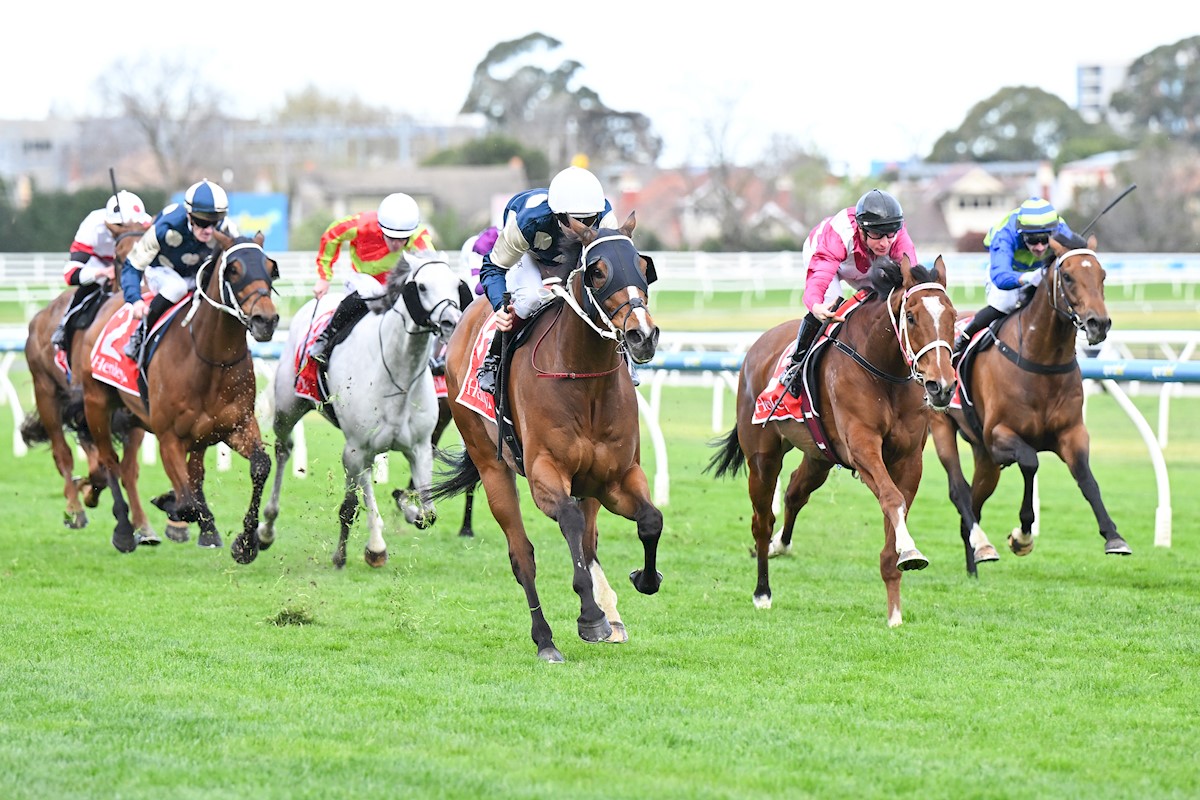
According to Vince Accardi’s data, the winning lanes were 6, 4, 1, 1, 2, 6, 8, 7, 8 and 7. Horses were able to lead and win, while others came from the tail. The track produced a new 1800m course record and they went within a whisker of the 1400m record in the Sir Rupert Clarke Stakes.
So, while the pre-meeting theatre certainly made my track report look ordinary, the racing probably went largely as scripted.
And as Scott Morrison once famously, and rather poorly, said: “I don’t hold the hose, mate.”
That said… it simply isn’t good enough
The movement of the rail from the 7m to 11m position meant punters were essentially betting on a vastly different track to the one they had expected. It brought wider lanes into play that would have been far more difficult to access with the rail in the advertised 7m position, potentially changing the shape of races and how the track played.
It simply isn’t good enough for those funding the show, the punters, nor those putting on the show: trainers, jockeys, staff and connections. Everyone prepares, analyses and invests based on the information provided, and something as fundamental as the rail position needs to be right.
Ultimately, incidents like this damage confidence and undermine the industry. Mistakes can happen, but transparency and accountability in the aftermath are critical. A strong response in the coming days, including an explanation of how it happened and what will be done to ensure it doesn’t happen again, is a must.
Willie at it again
Listening to Willie Pike post-race, I loved his suggestion that he was a “spot too close” on Cosmic Crusader, continuing his banter with the punters and form analysts who he suggested during the week should steer clear of offering observations on how races are run.
I’m all for it. Racing happens 364 days a year and there are few sports anywhere with the sheer volume of product we have to consume. We need to keep it interesting, and participants showing their true character, having strong opinions and being prepared to engage in a bit of back-and-forth is great for the game.
Similarly, participants need to understand that punters fund the sport and are equally entitled to an opinion. You didn’t hear commentators shy away from critiquing Mabior Chol’s pitiful output at the ’G on Saturday night, just as they were happy to praise Harris Andrews’ dominant second half after questioning his start to the game. Being a popular, well-funded sport comes with public scrutiny and assessment. The two are intrinsically linked. If people don’t care enough to analyse, criticise and debate performance, your sport is irrelevant and you’re effectively playing, or racing, for ribbons.
Reading between the lines, though, I hope Willie didn’t let the feedback from punters get into his head too much. He’s ridden more than 3000 winners and knows infinitely more about riding a horse than every desk and couch jockey in the country. Have some fun with it, absolutely, but don’t start second-guessing yourself because a few of us with keyboards thought you should have been a pair further back.
Pikey responds 🍿
📺 7plus, @Racing, Ch 78/68, Foxtel 529 or via our website. pic.twitter.com/fH6Tno9Z5W
— Racing WA TV (@RacingWATV) September 17, 2026
For the record, I thought his Underwood ride was perfect. They went a blistering early tempo, ran track-record time and, ultimately, I suspect a better horse was the reason Cosmic Crusader finished second. Settling a pair further back wouldn’t have changed the result.
Keep firing, Willie. Racing is better when its biggest personalities do.
Birdman soars into Cox Plate calculations as Lindermann’s Melbourne hopes fade
I doubt we’ll see Lindermann back in Victoria anytime soon. Blake Shinn said it all post-race: “Disappointing. I think he’s much better suited to Sydney, wasn’t comfortable this way of going.”
He was well backed throughout the week to win the Underwood and, while he set up a track-record time out in front, it was a day when they were running slick times and he was very poor late. His Caulfield record now reads three starts for three eighths, so there’s enough evidence to suggest Melbourne, or at least Caulfield, simply isn’t his go.
Plenty had talked up how great it would be to have Lindermann rolling along in front and setting a genuine tempo in a Cox Plate, but that now appears unlikely.
Meanwhile, Birdman has elevated himself right to the pointy end of Cox Plate calculations with a breathtaking Underwood win. He put them away by 1.8 lengths, looked to have something left in the locker and Ben Melham was adamant post-race that he is a genuine 2000-metre horse.
The market certainly agreed, with Birdman shortening from $15 into $6 for the Cox Plate.
Blind Raise terrific, but Shinn also got it spot on
While a few around him got itchy fingers in the Guineas Prelude, Blake Shinn kept a level head aboard Blind Raise, who ultimately belted his rivals.
His sectionals were delightful: 11.28, 11.34, 11.66, 11.58, 11.12 and 11.70. Shinn refused to panic when Wolf Gap and Toronado Valley whipped up around him, surrendering the lead before angling into the clear at the top of the straight. From there, Blind Raise did the rest.
Sure, Shinn had the horse underneath him, but he also nailed the ride. It was a good example of a jockey trusting his mount rather than reacting to what was happening around him.
And in what looks a moderate year for the Cox Plate, Blind Raise has the perfect three-year-old racing style to give the older horses something to catch with just 49.5kg on his back.
Mornington stables land home-track plunges
Brett Scott has been enjoying a nice little run in recent weeks and the stable landed another winner on Thursday when Corrontation Turbo was hammered from as much as $61 into an SP of $8.50, albeit with 21 cents in deductions.
Punters landed another big move later in the day when Kastun Star, $11 on race morning, was crunched into an SP of $4.80 before copping an Ethan Brown peach to win.
Brown had initially been booked to ride two horses in the race on Thursday morning, a challenge even for him, before ultimately sticking with Kastun Star and leaving Jamie Mott to take the ride on the then $2.40 favourite Mr Sioux. The market told a story from there, with Mr Sioux eventually drifting to $3.50 while Kastun Star continued to firm.
Go back and watch Kastun Star’s win at Tatura and you’ll quickly see why the money arrived. He was held up badly at a crucial stage before bursting through late to win with plenty in hand. The market identified a horse going places and Brown did the rest.